AI Overview tracking: how to measure whether Google cites you · Rankdelta
AI Overview tracking is not rank tracking. Measure citations in Google AI Overviews and AI Mode with Search Console first, then a prompt tracker, then pages that close the gap.
You rank third for a query that used to send demos. Traffic still fell. The missing layer is often an AI Overview that names a competitor while your blue link sits underneath. AI Overview tracking is the practice of measuring whether Google’s AI Overviews (and, where it appears, AI Mode) cite your URLs for a fixed prompt set — not whether you still hold position three.
That is the whole job. Rank tracking answers “where is my URL on the classic SERP.” AI Overview tracking answers “did the generated answer use me as a source today, from this locale, on this query.”
What Google says an AI Overview is
Google Search Central’s guide AI features and your website is the primary source. Three points from that page, not from a vendor blog:
- AI Overviews are shown when Google’s systems decide they are additive to classic Search. They often do not trigger.
- Both AI Overviews and AI Mode may use query fan-out: several related searches across subtopics, then a wider set of supporting links than a classic ten-blue-links result.
- To be eligible as a supporting link you must be indexed and eligible to appear in Search with a snippet. Google states there are no additional technical requirements.
If a tracker dashboard contradicts that — for example by promising a special schema type that “unlocks” AI Overviews — treat it as marketing. Google’s eligibility bar is ordinary Search.
Google also says clicks from results pages that include AI Overviews tend to be higher quality (people spend more time on the site). That is Google’s claim, not an Rankdelta lab result. It does not tell you your citation rate.
What “tracking” actually records
The August 2026 Google US SERP for ai overview tracking is a stack of tracker landing pages (AIClicks, SE Ranking, Seobility, SEO Monitor, OmniSEO), Google’s own AI Overviews product page, and a Reddit thread about mentions and click loss. Consensus is: buy a sampler that runs queries and stores citations.
A useful tracker, regardless of vendor, should store at least:
| Signal | What it means | What it is not |
|---|---|---|
| Trigger | Did an AI Overview (or AI Mode) appear for this query? | Your classic rank |
| Citation | Was your domain or URL listed as a source? | A guaranteed click |
| Mention | Was the brand named without a link? | The same as a citation |
| Competitors | Which other URLs were cited on that run? | A stable league table |
| Locale / device | Where and how the sample was taken | What every user saw |
Citation samples are volatile. The same prompt, a day later, from another datacenter, can cite a different set. That is why a one-off ChatGPT paste is not a measurement system.
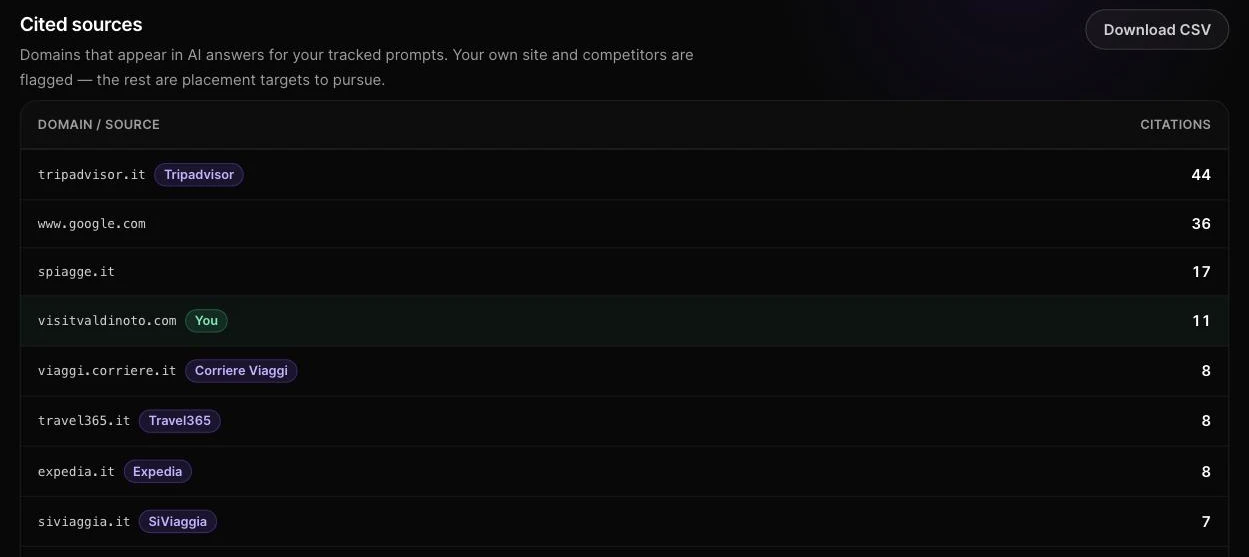
The citation side of tracking: the domains AI Overviews and Perplexity cited across twelve travel questions for a demo project. The tracked site is flagged You, competitors by name, and the unflagged rows are placement targets.
First-party layer: Search Console
Before you pay for a sampler, open Search Console.
- Performance → search type Web. Google includes sites appearing in AI features (AI Overviews and AI Mode) in overall search traffic here. Details: AI features and your website.
- Generative AI performance reports (announced 3 June 2026). Google launched dedicated views of impressions in generative AI features on Search (AI Overviews, AI Mode) and in Discover. The announcement lists: impressions, pages, countries, devices (Search), and dates. The reports were rolling out to a subset of websites.
What that announcement does not list: query-level citation lists, competitor URLs, or a per-prompt “were we cited?” column. If your GSC property does not show the new report yet, you are not broken — you are in the rollout.
Use GSC to answer: “are any of my URLs appearing in Google’s generative AI features at all?” Use a third-party tracker to answer: “on these 40 buying prompts, who got cited this week?”
The information-gain split: tracker-only vs tracker + writer + publish
This is the part the SERP landing pages skip. Tracking a gap is not closing a gap.
| Job | Tracker-only (Profound, Peec, SE Ranking AI toolkit, Otterly, AIClicks, Seobility) | Tracker + writer + publish |
|---|---|---|
| Sample ChatGPT / AIO / Perplexity | Yes, on the engines they sell | Yes, on the engines they sell |
| Show competitor citations | Usually | Usually |
| Draft the missing source page | No (or a separate product) | Yes |
| Publish to WordPress under your rules | No | In progress (drafts export today) |
| Typical buyer | Enterprise brand with a content team already | Small team that must act on the dashboard |
Rankdelta is AI SEO software by Agape Group GmbH. We sell the right-hand column. We have not run an independent lab that ranks those named trackers, and we do not assign them 9.7 scores. The table is a job split, not an award.
If you already have writers and a CMS workflow, a tracker-only tool can be enough. If the dashboard’s only output is “you are absent,” and nobody will ship a page this month, you bought a screenshot subscription.
A working measurement loop (without inventing a proprietary score)
- Pick 20–40 prompts that a buyer would type or speak: category (“best {thing} for {job}”), comparison, and “alternative to {incumbent}.” Freeze the list. Changing the list every week destroys comparability.
- Confirm GSC. Property verified, Web performance open, Generative AI report checked if it exists on your account.
- Sample on a schedule. Weekly is enough for most sites. Daily is for news and huge prompt sets.
- Classify each row: cited / mentioned / absent, plus the competitor URLs.
- Act only on absences you can win. If Google’s AI Overview cites a university PDF and a standards body, writing a listicle will not displace them. If it cites a competitor’s thin commercial page, that is a page you can actually write.
- Re-sample the same prompts after publish. If citation does not move in a few weeks, the issue is authority or retrieval, not “we forgot to add FAQ schema.”
Google’s own SEO hygiene still applies: allow crawling, keep important content in text, match structured data to visible text, internal links, page experience. That list is from Search Central, not a GEO startup.
Where this is still uncertain
- GSC vs third-party disagreement is normal. GSC impressions are Google’s census of your URLs in AI features. A tracker is a sample of queries you chose, from their crawlers. They will not match 1:1.
- AI Mode and AI Overviews are not the same model stack. Google says they may use different models and techniques, so citations diverge.
- Vendor “share of voice” is not standardized. Profound’s SOV is not Peec’s SOV is not a Semrush AI toolkit number. Compare one tool against itself over time.
- Italy: Ahrefs Keywords Explorer, Google Italy, 26 Aug 2026, shows
ai overview trackingat 0–10 monthly volume. English insert terms are a US/UK market. Italian pages should explain the mechanism in Italian, not stuff the English head term.
Sources
- Google Search Central, AI features and your website
- Google Search Central Blog, Introducing Search Generative AI performance reports (3 June 2026)
- Google, AI Overviews
- Semrush, Generative Engine Optimization: A Practical Guide — GEO as citation inside AI answers, not only rankings
Related: ChatGPT SEO tool, AI visibility tools, what AI visibility means, GEO tools, AI visibility checker. Free check: rankdelta.ai/#check.